The AI answered. Your CRM still shows nothing.
The AI demo answered the email. Your CRM still shows nothing. Forecast lies. Sales pays the redo. Good AI takes the request, decides from your rules, acts, and updates CRM so the team sees one source of truth.
The AI answered. Your CRM still shows nothing.
A quote request lands in a shared inbox on a Tuesday. An AI tool sends a polite reply. Opportunity amount, stage, and owner in CRM stay blank. The deal is invisible. The forecast is wrong. Sales quietly redoes the work.
That is not a model-quality story. It is a chat window with better manners, and a margin leak that never shows up on the slide deck.
On 14 September 2026, Forbes Tech Council published Why Most Agentic AI Pilots Never Make It Into Revenue Workflows. The missing piece in most AI decks is not another definition of clever software. It is what happens to a revenue task after the demo chat ends, and why a COO, ops lead, or founder-MD should care before they fund the next one.
Where the deal falls out of the system
A buyer asks for a quote by email.
1. Email in. The message lands in a shared inbox. The pilot is wired to a document dump: last year's PDF, a Notion page nobody owns, a scraped FAQ. It can summarise. It cannot trust a customer record.
2. Decide never sticks. List price is easy. The exception ("same as last quarter if they renew both sites") still lives in a spreadsheet named final_v7 and in someone's head. There is no rule set a new hire, or software, can finish from.
3. Act stops at a polite reply. The pilot produces a nice email. No quote line item. No owner. No due date. No next step on the opportunity.
4. CRM stays blank. Stage, amount, notes, and a clear trail stay untouched. Sales still copies numbers by hand. Finance still chases "what did we actually send?" Ops quietly redoes the job. Margin leaks every week while the pilot joins the scrap pile: demo worked, revenue workflow never saw it.
If that loop still dies in chat at your shop, you already know the cost. Invisible deals. A forecast that looks tidy and is wrong. Redo labour that never hits the pilot business case.
The scrap pile, in numbers
Forbes cites S&P Global Market Intelligence's 2025 enterprise AI survey: the share of businesses that scrapped most AI initiatives rose to 42%, from 17% the prior year. The average organisation abandoned 46% of AI proof-of-concepts before production.
BCG's Build for the Future work (September 2025, 1,250+ companies): only 5% generating AI value at scale; 60% report little or no measurable value. Top blockers: unstructured-data expertise (79%) and access to high-quality data (68%), ahead of hallucinations.
Read that against the path above. Without clear documents and data access, the next project dies in the same scrap pile. The surveys point at documentation, naming, and access, the layer that lets a request become a decision, an action, and a CRM update, not at another model bake-off.
AI that updates your records
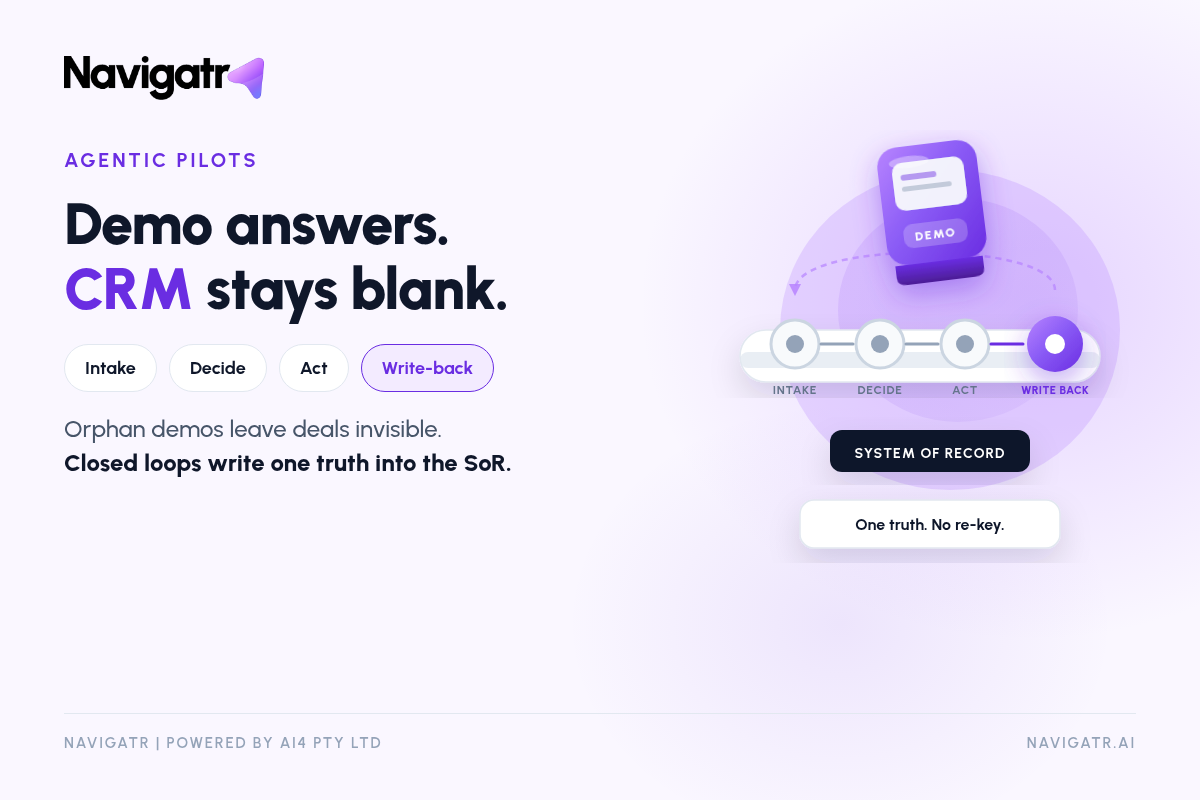
Good AI does not just chat. On the same quote request, a production path looks like this:
Request - read the ask, identify the account, pull the customer record and open opportunities from CRM.
Decide - apply documented pricing and exception rules. Escalate only when the rule set says escalate. If a competent new hire cannot finish the decision from documented systems alone, stop and fix the documentation. Do not pretend the software will invent the missing rules.
Act - create or update the quote, assign an owner, set the next step. Draft language is a side effect, not the product.
Update CRM - save status, amount, owner, and a clear trail into CRM, and notify the channel the team already uses. The loop closes when CRM matches reality without a human re-key. One source of truth. No reply left hanging outside the system. Forecast and CRM finally agree.
No human in the loop for the happy path. A human on the exception path the rules already named. That is the bar. Fancy labels are irrelevant until the record updates.
The new-hire test
The practical test on the Forbes page is simple: if a new hire cannot complete the task from documented systems alone, fix documentation and naming before you deploy AI on that workflow.
The author's Amazon contract-taxonomy anecdote lands for a reason. Months of taxonomy work came before usable accuracy. That is not anti-AI. That is anti-theatre. Software cannot reliably close a revenue loop whose rules still live in tribal knowledge and inboxes.
What to do next
Find where deals fall out of the system. Fix the basics. Then build AI that updates the record, not another chat that leaves CRM blank.
Start at navigatr.ai.
Sources: Forbes Tech Council, 14 Sep 2026 (citing S&P Global; BCG Build for the Future)