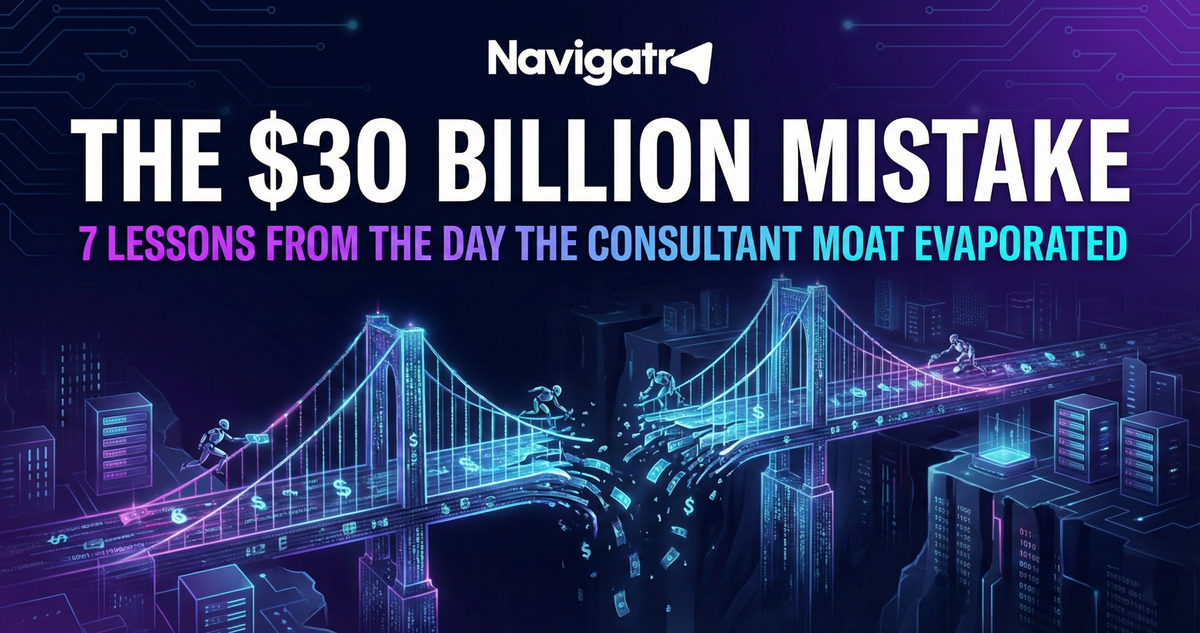
The $30 Billion Mistake: 7 Lessons from the Day the Consultant Moat Evaporated
On Monday 23 February 2026, IBM recorded its sharpest single-day decline since October 2000. Shares plunged 13.2%, wiping more than $31 billion in market value in a single session. The stock has now fallen 27% in February alone; its worst monthly performance since at least 1968, according to Bloomberg data.
The catalyst wasn't a missed earnings target. It was a blog post.
Anthropic, the AI lab behind Claude, published a Code Modernisation Playbook and accompanying blog post explaining how their Claude Code tool can automate the exploration and analysis phases of COBOL modernisation. The phases that, until now, required armies of consultants and years of billable hours.
The market's reaction was immediate. IBM wasn't the only casualty, Accenture and Cognizant Technology Solutions both fell on the same day. A major software ETF is now down 27% for the year, on track for its biggest quarterly drop since the 2008 financial crisis.
The message from Wall Street was clear: the consultant moat is being drained.
The Death of the Three-Year Discovery Phase
For decades, modernising legacy COBOL code was the ultimate corporate tax. An estimated 95% of ATM transactions in the United States still run on COBOL. Hundreds of billions of lines of COBOL run in production every day, powering critical systems across banking, insurance, airlines, and government.
The problem was never the code itself, it was that nobody understood it any more. The developers who built these systems retired years ago, the documentation never kept up, and COBOL is now taught at only a handful of universities worldwide. Finding engineers who can even read it gets harder every quarter.
This created a lucrative industry: you needed an army of specialist consultants to spend years mapping out undocumented logic that everyone was too terrified to touch. Discovery alone could cost more than the actual migration. It was slow, expensive, and built on the scarcity of human memory.
Anthropic's announcement suggests that this entire discovery phase can now be automated. Claude Code can map dependencies across thousands of lines of code, document workflows, and identify risks that would take human analysts months to surface. The company claims teams can now modernise COBOL codebases in quarters instead of years.
We are moving from a world where understanding the code cost more than replacing the code.
7 Lessons for the New Era
If you're currently managing a modernisation project, or paying consultants to manage one for you, here is the Navigatr playbook for what comes next.
1. Bill for Outcomes, Not Discovery
Discovery is no longer a six-month engagement. AI can automate the exploration, dependency mapping, and workflow documentation that used to consume the majority of modernisation budgets. If your vendor is still quoting discovery phases measured in quarters, ask them why.
The value has shifted from understanding the problem to solving it correctly. Price accordingly.
2. Oversight Is the New Expertise
You don't need COBOL typists. You need architects who can audit AI-generated refactoring, validate that business logic has been preserved, and ensure compliance with regulatory requirements. Jefferies analyst Brent Thill maintained a Buy rating on IBM after the crash, arguing that translating code is only 10% of the modernisation journey. Security, reliability, and data integrity make up the other 90%, and that's where human expertise still matters.
The role of the specialist has changed from doing the work to governing the work.
3. Drain the Complexity Moat
"Messy code" has been the excuse for institutional inertia for decades. If your organisation has been told that legacy modernisation is too risky or too expensive to attempt, revisit that assumption. The tools available today didn't exist six months ago.
Complexity is no longer a moat; it's a data problem with a rapidly improving toolset.
4. Speed Is a Quality Metric
Quarters are the new years. If your modernisation roadmap spans half a decade, it's already obsolete. The market just demonstrated, in real time, that it will reprice entire companies based on the speed at which legacy systems can be modernised.
Agility isn't a nice-to-have. It's a valuation metric.
5. Cannibalise Your Own Revenue
This is the hardest lesson for consulting firms. Consultants who don't introduce these tools to their clients will be replaced by consultants who do. IBM itself launched an AI coding assistant for mainframes in 2023, but the market clearly believes Anthropic's approach, which migrates code off IBM hardware entirely, is the bigger threat.
The safest position is to be the one disrupting your own business model before someone else does.
6. Wrap Before You Replace
Use AI to create API wrappers around legacy logic for immediate innovation while cleaning up the back end incrementally. Anthropic's own playbook recommends incremental implementation with continuous validation; each step either succeeds and gets verified, or fails while the scope is small.
You don't have to migrate everything at once. But you do have to start.
7. Govern the Data, Not Just the Code
AI can read the logic, map the dependencies, and generate the migration path. But humans must own the data sovereignty, security classification, and regulatory compliance decisions. For Australian organisations, this means understanding where your data sits, which jurisdiction governs it, and who has access. These are questions that no AI tool should answer on your behalf.
The governance layer is the one thing that cannot be automated. Make it your competitive advantage.
Navigatr Verdict
Legacy systems are no longer a barrier to agility, they are a data problem that has been solved faster than anyone expected. IBM's $31 billion lesson proves that the market has already priced in this shift.
The question for the C-suite is no longer how much are you willing to spend to maintain the past. It's how quickly can you use these tools to leave it behind, and, do you have the governance frameworks to do it safely?
If you're an Australian enterprise navigating this transition, talk to us. We help organisations move from experimental AI to strategic advantage, with governance built in from day one.
Ben is the CEO of AI4 Pty Ltd and founder of Navigatr, an AI adoption consultancy helping Australian enterprises implement AI with governance-first strategies. Helping teams learn, experiment, build and adopt AI - along with custom solutions that challenge the big players.
Frequently Asked Questions
Why did IBM stock drop 13% on 23 February 2026? IBM shares fell 13.2% after Anthropic announced that its Claude Code tool can automate COBOL modernisation; the exploration and analysis phases that traditionally required years of consulting work. The drop wiped over $31 billion in market value.
What is COBOL and why does it matter? COBOL (Common Business-Oriented Language) is a programming language from the late 1950s that still powers an estimated 95% of ATM transactions in the US. Hundreds of billions of lines of COBOL run daily across banking, insurance, and government systems worldwide.
What is Anthropic's Code Modernisation Playbook? Anthropic released a playbook alongside its Claude Code announcement outlining how AI can automate legacy code discovery, map dependencies, assess migration risks, and incrementally convert COBOL to modern languages like Java or Python.
Does this mean COBOL is dead? Not immediately. Many critical systems will continue running COBOL for years. But the economics of maintaining versus modernising have shifted dramatically; the discovery phase that made modernisation prohibitively expensive can now be automated.
What should enterprises do about legacy COBOL systems now? Start by reassessing any modernisation timelines that were set before AI tools existed. Commission a scoped pilot using AI-assisted discovery, establish governance frameworks for migration decisions, and move from multi-year roadmaps to quarterly milestones.